IBM Maximo Application Suite (MAS) 9.2 marks a major milestone in the evolution of enterprise asset management for asset-intensive industries in Canada, including Energy & Utilities, Oil & Gas, Mining, Heavy Manufacturing, Chemicals, and Transportation.
In a country where organizations manage vast, geographically distributed infrastructure, from power grids and hydroelectric plants to mining operations and transportation networks, asset reliability, operational continuity, and safety are critical business imperatives.
Since its transformation into a unified cloud-native architecture, MAS brings together maintenance management (EAM), asset performance management (APM), field mobility, safety, and compliance into a single integrated platform.
With version 9.2, IBM takes a decisive step forward: artificial intelligence no longer just delivers insights, it acts.
MAS 9.2 represents the shift from analytical AI to agentic AI, capable of orchestrating complex workflows, automating decisions, and actively supporting field and operational teams in real time.
Key evolution highlights include:
- • AI becomes actionable, persistent, and agentic
• Field mobility and workforce empowerment become central to operations
• Reliability, APM, and condition-based maintenance (CBM) move from concept to large-scale operational execution
• User experience, configurability, and platform usability are significantly enhanced
The Evolution of Maximo into MAS
To understand the significance of MAS 9.2, it is important to revisit the evolution of the platform.
IBM Maximo, originally launched in the 1990s, started as an on-premise Enterprise Asset Management system designed to help organizations track and maintain physical assets.
Over time, IBM significantly expanded its capabilities to include IoT connectivity, advanced analytics, mobile workforce enablement, and predictive maintenance functionalities.
A major strategic shift occurred with the introduction of the Maximo Application Suite, which unified all capabilities under a single licensing model and a containerized architecture based on Red Hat OpenShift. MAS now supports on-premise, hybrid, and fully cloud-based deployments via IBM Cloud.
MAS 9.2 continues this trajectory by fully integrating generative and agentic AI capabilities through IBM watsonx, IBM’s enterprise AI platform.
This integration enables MAS 9.2 to deliver AI agents capable of understanding operational intent, executing end-to-end tasks, and connecting heterogeneous enterprise systems without complex integration layers, an important advantage for Canadian enterprises operating large and often fragmented industrial ecosystems.
Key Use Cases of MAS 9.2 in Asset-Intensive Canadian Industries
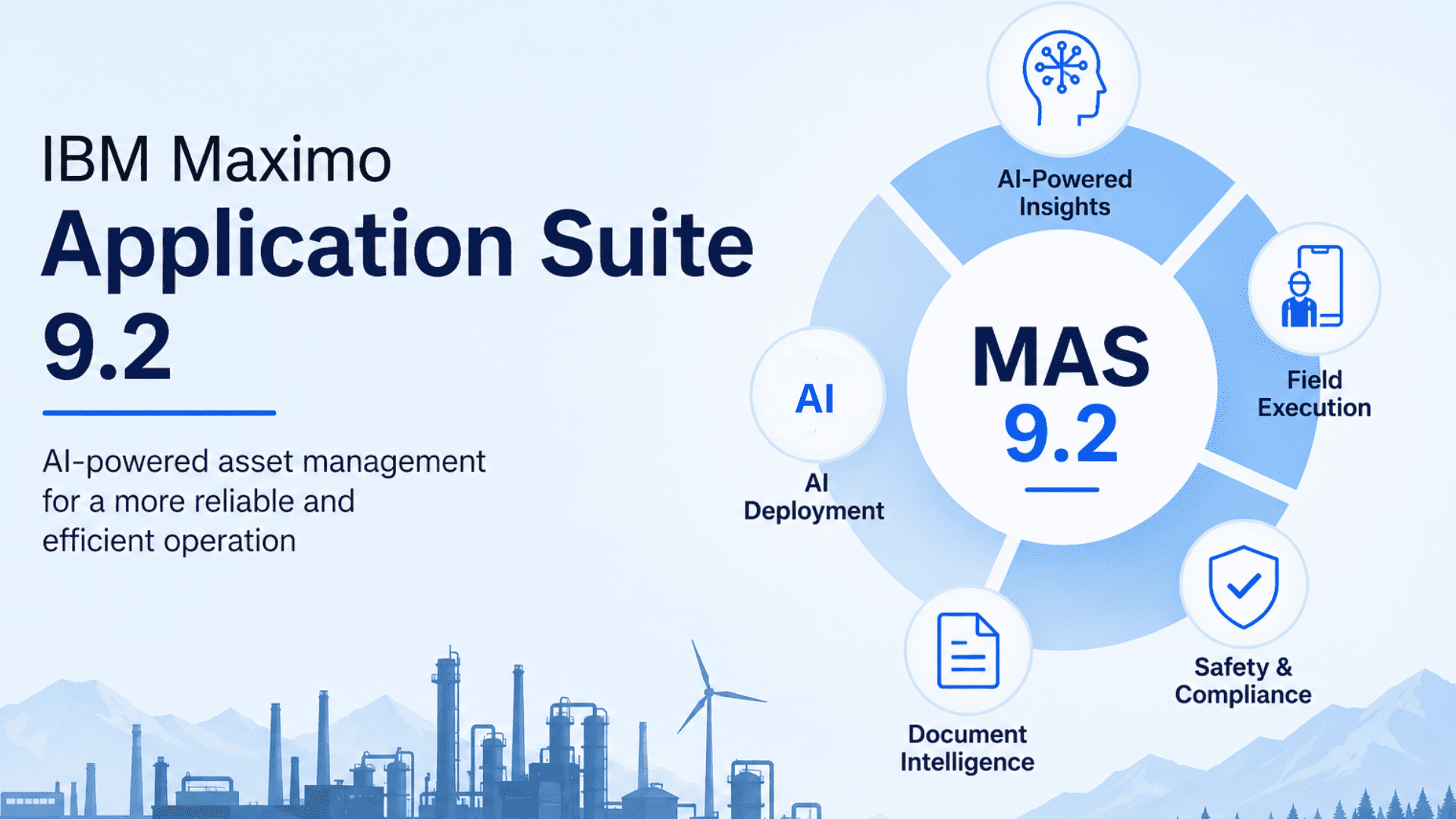
MAS 9.2 is structured around five core use case families, each addressing critical operational challenges faced by industrial organizations in Canada.
1. Asset Intelligence: From Data Complexity to Actionable Maintenance Decisions
Understanding asset health is often complex and time-consuming, requiring reliability engineers to manually analyze fragmented data across multiple systems to assess equipment condition. With AI-augmented asset intelligence, this information is now consolidated, analyzed, and automatically explained through clear summaries and a unified operational view. AI does not stop at describing asset status: it identifies likely failure scenarios and recommends prioritized maintenance actions based on criticality and operational impact. This approach is particularly relevant for Canadian industries managing aging infrastructure in utilities, oil sands, and mining, where downtime can have significant financial and environmental consequences. It helps reduce unplanned outages, accelerate decision-making, and improve asset availability while optimizing maintenance costs.
2. Field Execution: Real-Time Intelligence for Field Operations
In field operations, maintenance teams are often slowed down by limited access to real-time information and fragmented systems, leading to delays and higher risk of errors. With AI embedded in mobile solutions, technicians now receive real-time guidance directly on-site, with instant access to asset history, recommendations, and best-practice procedures. AI can also simulate different intervention scenarios before execution, enabling teams to choose the most effective strategy without operational risk while improving real-time decision-making. Combined with visual inspection capabilities via mobile devices, this approach enables rapid anomaly detection without specialized equipment. The result is faster and more reliable field execution, significantly improving first-time fix rates across distributed Canadian industrial environments.
3- Safety & Compliance: Unifying safety and compliance in operations
Safety and compliance are no longer managed as standalone processes but are fully embedded into operational workflows. This reduces risks associated with missed steps or manual handling and ensures that every intervention systematically adheres to safety requirements. With integrated safety workflows, centralized incident management, and real-time compliance visibility, organizations maintain a continuous audit-ready posture. In Canada, where regulatory frameworks in energy, mining, and utilities are particularly strict, this capability ensures stronger governance, reduced operational risk, and improved workforce safety across all sites.
4- Document Intelligence: Turning documents into operational intelligence
Critical information, often stored in complex documents such as PDFs, scans, engineering reports, or contracts, previously required time-consuming and error-prone manual processing. With AI-powered document intelligence, this content is now automatically analyzed, extracted, and validated, transforming unstructured data into actionable operational insights. This automation dramatically accelerates access to key information, such as lease abstraction or equipment documentation, reducing processing time from hours to minutes while improving accuracy and reducing human error. Canadian organizations benefit from faster decisions, higher data quality, and seamless integration into their maintenance and asset management systems across large-scale infrastructures.
5- AI Deployment: Accelerating work with agentic AI
Work environments are often slowed down by manual processes, disconnected systems, and the difficulty of leveraging dispersed enterprise data. With agentic AI, these limitations disappear through an approach that directly connects data, decisions, and operational execution. Work no longer stops at analysis or recommendation; it automatically moves into execution without requiring human intervention at every step. This capability transforms requests into end-to-end actions, orchestrates processes across systems, and relies on intelligent agents capable of understanding business intent and executing tasks from start to finish. The result is a significant reduction in manual effort, smoother execution, and teams refocused on high-value analytical and decision-making activities.
Expected benefits and business value
1- Reduction of unplanned downtime
Thanks to predictive intelligence and AI-generated condition summaries, maintenance teams can anticipate failures before they occur. Combined with prioritized recommendations, this capability significantly reduces unplanned downtime, which in sectors such as oil sands, utilities, and mining in Canada can reach extremely high operational costs per hour.
2- Improved first-time fix rate
By providing field technicians with the right information at the right time, asset history, recommended procedures, and what-if analysis, MAS 9.2 increases first-time fix rates. Each avoided return visit translates into cost savings and improved equipment availability across distributed Canadian industrial sites.
3- Strengthened safety and compliance
Integrating safety workflows directly into operations reduces the risk of missing critical procedures. Incident management and real-time compliance visibility help organizations remain continuously audit-ready, reducing regulatory exposure and associated penalties, especially relevant in highly regulated Canadian sectors such as energy, mining, and utilities.
4- Increased productivity through automation
The agentic AI capabilities of MAS 9.2 automate repetitive and low-value tasks: document extraction, work order creation, asset data updates, and workflow orchestration across systems. This automation frees teams to focus on higher-value analytical, operational, and strategic activities.
Competitive positioning and IBM strategic vision
MAS 9.2 positions IBM as a leader in intelligent EAM, competing with SAP EAM (integrated into S/4HANA), Oracle Enterprise Asset Management, Infor EAM, and niche players such as Hexagon and AVEVA.
IBM’s differentiation is based on three pillars:
- • Native integration with IBM watsonx, providing AI depth that is difficult for competitors to replicate
• Open architecture built on Red Hat OpenShift, enabling maximum deployment flexibility (cloud, hybrid, on-premise), essential for Canadian data sovereignty and regulatory constraints
• The extended IBM ecosystem: integration with IBM Instana for observability, IBM Turbonomic for resource optimization, and IBM digital twin solutions
IBM’s strategic vision with MAS 9.2 is clear: to make asset management an AI-first domain where every operational decision is assisted, every workflow is optimized, and every asset is continuously monitored.
Conclusion
IBM Maximo Application Suite 9.2 represents a major evolution in intelligent enterprise asset management. By shifting from insight-driven AI to action-driven, agentic, persistent, and connected AI, MAS 9.2 meets the expectations of Canadian organizations seeking to transform maintenance into a competitive advantage in demanding industrial environments.
The five major use case families (Asset Intelligence, Field Execution, Safety & Compliance, Document Intelligence, and AI Deployment) cover the full operational lifecycle of industrial assets, from predictive analytics to field execution, regulatory compliance, and document intelligence.
For Canadian enterprises already using previous versions of Maximo or MAS, upgrading to version 9.2 is an opportunity to maximize existing investments while accessing the most advanced AI capabilities on the market. For organizations considering a new EAM platform, MAS 9.2 provides a gateway into the era of AI-augmented intelligent maintenance.
Contact us to start your transition to MAS 9.2 today.